







Career Advancement“So, Tell Me About Yourself.” What Are Interviewers Really Asking?
Resume Writing
The Truth About ATS in 2026: 5 Resume Myths That Hurt Your Job Search
Reading time 10minYou've tailored your resume perfectly. You've triple-checked every word. You hit "submit" on what feels like your dream job, and then... nothing. Just silence.
Sound familiar? If you're like most job seekers, you've probably blamed the dreaded ATS (Applicant Tracking System) for your applications disappearing into a black hole. After all, everyone says these systems automatically reject 75% of resumes before a human ever sees them, right?
Here's the truth: that's still mostly myth, not reality in 2026.
And the longer you believe it, the more time you'll waste trying to "beat" a system that isn't actually your main enemy. In this post, we're busting five of the biggest ATS myths with the latest recruiter insights and data, and showing you what actually gets resumes noticed by real people in today's hiring landscape.
What Is an ATS, Really?
Before we dive in, let's clarify what an Applicant Tracking System does in 2026.
An ATS collects applications, parses key info (contact details, experience, skills), and stores everything in a searchable database. It tracks where candidates came from, which role they applied to, and their status in the process. Think of it as a powerful organizer, not an autonomous robot deciding your fate.
Nearly 99% of Fortune 500 companies (and 93%+ of recruiters overall) use an ATS to handle the flood of applications that come with easy online apply buttons. Many now integrate AI or automation (around 79% of organizations per recent reports), which can help with parsing, initial ranking, or suggesting matches. But even with these upgrades, the ATS doesn't usually make final rejection calls. It's built for tracking and efficiency, not terminator-style decisions.
Here's the typical flow when you submit:
- The ATS parses your resume. Extracts data into fields for searching/filtering.
- Your application gets stored. In a database recruiters can query.
- Recruiters review. Via keyword searches, filters, ranked lists (sometimes AI-assisted), or just chronological order.
What's still missing in most cases? Blanket automatic rejection based on content alone. The "T" stands for Tracking, not Terminator. While AI features are growing (with projections showing 83%+ of companies using AI for resume screening), human review remains the standard, especially due to legal compliance around bias and fairness.
Myth #1: The ATS Automatically Rejects Your Resume If You Don't Have the Right Keywords
The Myth: No callback? Must be because you missed "data-driven decision making" or "end-to-end ownership", the system filtered you out.
The Reality: Only about 8% of recruiters enable broad content-based auto-rejection; 92% still rely primarily on human review. Knockout questions (e.g., "Do you have at least 3 years of relevant experience?") can auto-filter, but missing keywords alone rarely triggers outright rejection.
When keywords matter, it's usually for search/ranking. Recruiters use them like Ctrl+F to pull up matches from the pile, or AI helps surface top fits. The old "75% auto-rejected" stat lacks solid backing and persists mostly via social media echo chambers.
What This Means for You:
Silent treatment usually means your resume didn't pop for a busy human (or got buried in volume). Not a keyword apocalypse.
What to Do Instead:
-
Skip stuffing. Use relevant terms naturally in achievements.
-
Example: Instead of "team leadership," say: "Led a team of 6 across two regions, delivering all quarterly goals ahead of schedule.”
Focus on making your value crystal-clear fast.
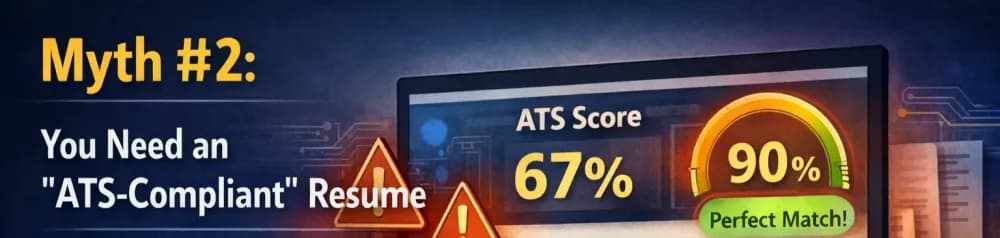
Myth #2: You Need an "ATS-Compliant" Resume with a Perfect Match Score
The Myth: Third-party scanners give you a "67% ATS-friendly" score. Tweak until it's 90%+ to "get through."
The Reality: Those scores are often invented marketing metrics, not tied to what recruiters actually see or use. Many (56%+) ignore or lack AI match scores; only a small fraction rely on them heavily. Real ATS ranking (when AI-assisted) prioritizes relevance, but humans override.
What This Means for You: Chasing fake numbers can strip away personality and impact, hurting more than helping.
What to Do Instead:
Aim for "reader-compliant". Clean, skimmable in 5 to 10 seconds.
- Standard fonts, no heavy graphics or tables.
- Clear headings (Work Experience, Skills).
- Strongest achievements up top, with numbers.
Clarity beats arbitrary scores every time.
Myth #3: The White Font Trick Works
The Myth: Hide job description keywords in white text. ATS sees them, humans don't.
The Reality: Terrible idea. ATS extracts everything (hidden text included) into plain view. When recruiters copy, export, or share, it appears, making you look sneaky and desperate.
What This Means for You: It screams "I'm gaming the system" instead of "I'm qualified."
What to Do Instead:
Highlight real usage: "Streamlined onboarding process, cutting average training time from 10 to 6 days.”
Prove skills with evidence, not tricks.
Myth #4: ATS Systems Use AI to Screen and Reject Candidates
The Myth: Cutting-edge AI auto-evaluates, scores, and rejects before humans.
The Reality: Many ATS are still legacy trackers (though AI integration is rising, 79%+ have some automation). Over 90% of resumes get at least brief human eyes in most setups. Full auto-rejection is rare outside basic knockouts. Bias and compliance laws (EEOC, ongoing lawsuits) keep humans in the loop. AI often ranks or suggests, not decides.
What This Means for You: Don't obsess over "beating AI." Write for the human skimming under time pressure.
What to Do Instead:
- Lead with impact and quantifiable results.
- Scannable format, clear relevance.
Recruiters scan for fit fast. Clarity wins.
Myth #5: Getting Rejected Immediately Means the System Filtered You Out
The Myth: Instant rejection email = bot decided you're unqualified.
The Reality: Usually knockout answers, clear mismatches, or filled roles. Volume is the killer. Hundreds or thousands apply; recruiters review maybe 20 to 30 deeply per day. Many qualified apps get skimmed or skipped due to overload, not auto-filters.
What This Means for You: You're in a huge pool. An instant "no" usually isn’t about your resume, it’s just the reality of volume and timing.
What to Do Instead:
- Stand out fast. Value in first lines, numbers, scannable layout.
- Apply early (first 48 to 72 hours).
- Network
What Actually Works: A Better Approach in 2026
With AI helping sort and rank more than before, the fundamentals haven't changed. Prioritize humans.
-
Write for the Reader
Scannable: Headings, concise bullets, top-line impact.
-
Show Business Impact
Outcomes over duties: "Closed 300K in new client revenue in Q4" beats "Managed client accounts.”
-
Bridge the Title Gap
Clarify mismatches: "Software Engineer (Built scalable API for 50k+ users).”
-
Tailor Smartly (No Overkill)
Pull 3 to 5 key skills or relevant job titles naturally, and show achievements that match.
Tools like Resume AI 3.0 (from TieTalent) can make this step faster and more effective without falling into keyword-stuffing traps. It takes your existing experience, the job description you paste in, and generates a tailored, ATS-optimized CV and cover letter, pulling in relevant terms naturally, structuring achievements for quick scanning, and outputting everything in editable .docx format. You keep full control: review, tweak phrasing to sound like you, add personal touches, or refine quantifiable impacts. It's especially useful when you're applying to multiple roles and want to avoid starting from scratch each time, saving hours while staying focused on what recruiters actually value: clear relevance and results. The key? Use it as a smart assistant, not a replacement for your story.
The Bottom Line
The problem isn't rejection. It's invisibility in overwhelming volume. ATS (even AI-enhanced) organizes the chaos, but recruiters decide. You have 6 to 7 seconds to hook a human.
Ask: "Does this scream value to someone skimming?" Not "Did I beat the bot?"
Quick Action Steps
- Ditch tricks (white text, stuffing).
- Rewrite top bullets for impact and numbers.
- Simplify format (standard, clean).
- Test: Show a friend. "Why am I qualified in 10 seconds?"
- Apply strategically plus network early.
You're not outsmarting software. You're helping a busy human see why you're the fit. Do that well, and the rest follows. Good luck out there.
Looking for a job that matches your aspirations and skills? Join TieTalent today. Our platform matches professionals with companies that value what you bring to the table, including those seeking talents who know how to navigate modern hiring processes effectively.
Author
Antonio Aguilar Geronazzo
Marketing Manager - TieTalent
As the Marketing Manager at TieTalent, Antonio Aguilar is known for his adaptability and innovative approach. Having spent over 20 years in various industries, he contributes a broad spectrum of valuable insights. Antonio’s deep understanding of diverse markets and consumer needs enables him to create fresh and effective marketing strategies. He excels in combining his expertise with real-world insights to create marketing approaches that are not only effective but also genuinely connect with people. His articles, recognized for their insightful information and reliable references, have been key in forging strong relationships with diverse clients and audiences.

